
Learning with FR-1 and Rei is a dialogue series where FR-1, an AI robot, and Rei, a university student, explore the World Robot Summit (WRS) 2025 Fukushima.
In this episode, they dive into the Harsh Environment Drone Challenge (HEDC)—the toughest drone race in the world—and break down its missions and strategies in a clear, accessible way.

FR-1: Hello, Rei! Today I’d like to talk about one of the most exciting competitions at
WRS2025: the Harsh Environment Drone Challenge, or HEDC for short.
Doesn’t just hearing the word “drone” get you a little excited?
Rei : Hello, FR-1! I’m really interested in drones! What kind of competition is HEDC?
1. Why HEDC Matters: The Story Behind the Challenge
FR-1: HEDC is not a typical drone race. Let me start by explaining its purpose and significance.
FR-1: The Fukushima Institute for Research, Education and Innovation (F-REI) is conducting research and development on robots and drones
that can operate in “harsh environments,” such as decommissioning sites, natural disasters, and forests.
This work stems from Fukushima’s experience during the Great East Japan Earthquake.
Rei : I see, so Fukushima’s experience was the starting point.
What exactly counts as a harsh environment?
FR-1: At F-REI, a “harsh (or extreme) environment” is defined as one where conditions such as temperature, pressure,radiation, gravity, magnetism,
or pH deviate significantly from what ordinary organisms (including humans) can tolerate.
The goal is to have robots operate in places too dangerous for humans.
FR-1: In HEDC specifically, drone technology is tested in three kinds of harsh environments.
The competition does not prepare ideal flight conditions in advance.
● Completing missions within a set time even in bad weather (wind, rain, fog)
● Operating in environments with disrupted or delayed communication
● Flying in areas with many obstacles (such as power lines, trees, or towers)
Rei : Wow, that all sounds really difficult… And the drones have to fly in those conditions?
FR-1: Exactly. The core idea of HEDC is how drones can save lives from the air in large-scale disasters where roads are cut off and ground
access is impossible.
It’s not just about flying fast—it’s about developing innovations that can actually be useful at real disaster sites.
Rei: So, the challenge is about proving whether drones can really be relied upon in the field.
2. The Rules of HEDC: Three Missions
FR-1: Teams may attempt the three missions sequentially or simultaneously within a one-hour timeframe.
FR-1: The competition's going to be held at the Fukushima Robot Test Field (RTF) and the areas around it, especially the Odaka district in
Minamisoma City.
We'll set up the disaster response headquarters at the RTF Namie Runway, and that's where the drones will take off.
Mission 1: Wide-area Exploration
Drones fly over the disaster site and identify which roads are passable and which are blocked.
From the aerial images, they determine safe evacuation routes and map them out.
Mission 2: Rescue and Supply Delivery
Next, drones must locate people in need of help and deliver supplies to them.
Accuracy in dropping or landing the supplies and reporting the victims’ conditions is crucial.
Mission 3: Indoor Exploration of a Remote Building
Finally, drones have to investigate the inside of a distant building.
A parent drone (outside) and a child drone (inside) work together to explore the interior, searching for victims and hazards in dark, confined spaces.
Rei : So each mission is connected to actual rescue activities! It’s really practical.
FR-1: That’s right. It’s not just a performance show; it’s a test of whether drones can contribute to real disaster response.
3. Strategies for Scoring High in HEDC
Rei: FR-1, I’d like to know—what strategies are important to score high in HEDC?
FR-1: That’s a good question, Rei.
There are two key strategies.
FR-1: First is autonomous operation.
Of course, remote control is also allowed, but autonomous flight and task completion earn higher points.
Why do you think that is?
Rei: Hmm… maybe because in real disasters, communication can get cut off, so it’s safer if drones can fly on their own?
FR-1, I’d like to know—what strategies are important to score high in HEDC?
FR-1: Exactly! In large-scale disasters, communications infrastructure may be damaged.
If drones can continue their missions autonomously even when signals are unstable, that’s extremely valuable.
FR-1: The second point is stable communication.
Even though autonomy is valued, drones still need to transmit images, video, and data reliably to operators and rescue teams.
If the connection drops at a crucial moment, critical information could be lost.
So balancing autonomous operation and stable communication is very important.
Rei: So, autonomous control and AI are super important, right?
And safety measures also need to be really solid.
FR-1: Exactly. HEDC is a seriously tough competition that doesn't just test technical skills, but also how well teams can solve problems in
real-world disaster situations.
Keeping those points in mind when you're putting a team together and getting ready will be key to scoring big.
If you're just watching, it's helpful to pay attention to these things:
Mission 1: How accurately can they find a passable route?
Mission 2: Can they reliably deliver the right supplies to the right place?
Mission 3: Indoor exploration accuracy and how well the parent and child units work together.
Across all missions: Perfect autonomous operation and highly stable communication.
Rei: The competition covers a huge area, from Namie Town all the way to the coast of Minamisoma City, but where can I actually go to watch it?
FR-1: You can catch the live coverage at the Fukushima Robot Test Field (RTF) in Minamisoma City.
They'll have experts giving easy-to-understand live commentary.
Plus, the entire event will be streamed live on YouTube, so you can watch from anywhere.
Oh, and the competition teams' paddocks (maintenance areas) will be set up at Cosmos Arena in Namie Town.
You can check out their preparations before and after the competition, and see the actual gear up close.
4. Conclusion
Rei: Thanks, FR-1! Now I understand that HEDC is not just a competition, but also a place to test whether drones can actually be useful in
disaster situations.
FR-1: Exactly, Rei. The value of HEDC lies in combining technological development with real-world disaster response.
By testing drones under tough conditions, we can take one step closer to making them practical tools for saving lives.
Rei: I’ll be sure to watch HEDC at WRS2025 closely!
FR-1: Great! Let’s look forward to the exciting performances of the participating teams.
Rei: Watching the competition with expert live commentary on the broadcast, and also seeing all those cutting-edge drones and the teams’ behind-the-
scenes at the Namie Town paddock – I'm seriously stoked for this!

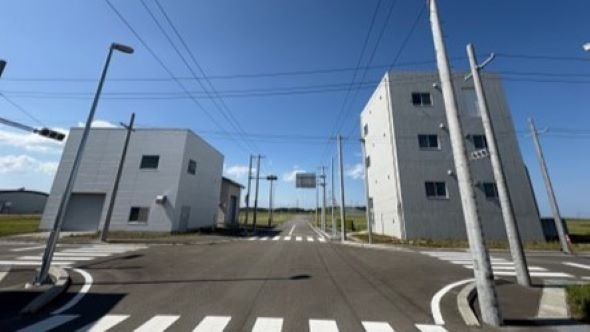
On the left: Drones from the sea approach the RTF urban field, flying over power towers.
On the right: Small drones and robots navigate building interiors, avoiding obstacles like other buildings, traffic lights, and power lines.
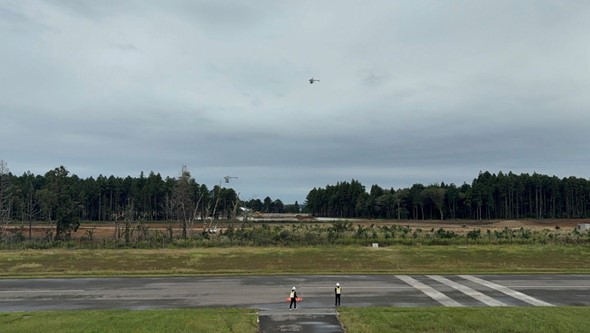
On the left: Drones at HEDC use the RTF Namie Runway for take-off and landing, flying up to 13km.
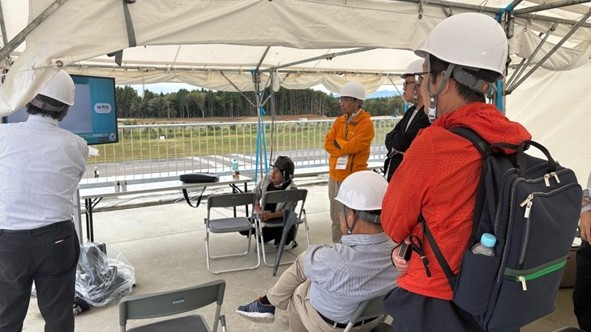
On the right: A disaster countermeasures headquarters for mission operations will be set up at RTF Namie Airfield.
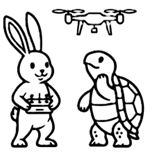


Hare: Hey, Tortoise! I heard you’re joining the HEDC race too.
Tortoise: Well, well, Hare. Looking for a rematch after the last race?
Hare: I won’t make that mistake again.
Falling asleep mid-race? Never again.
Tortoise: You won’t have time for naps anyway.
We have to clear three missions within just one hour.
Hare: Hah! With these long ears soaring through the sky at top speed,
HEDC will be a piece of cake.
Tortoise: Did you actually read the rulebook? It’s not just a speed race.
Hare: I get it. With these sharp eyes and ears, spotting targets on the
ground will be a breeze.
Tortoise: So those red eyes aren’t just for show, huh?
Hare: Exactly. You can’t beat me in physical ability, Tortoise.
Tortoise: Oh, but I can.
Hare: What!?
Tortoise: I’ve lived ten thousand years. I’ve got wisdom on my side.
Hare: Ah, so you mean your data processing is faster.
Tortoise: And one more thing.
You know that old song, “A baby tortoise rides on its parent’s back”?
Hare: !!
Tortoise: Mission 3 is a long-distance one, with tight spaces to explore.
So I’ll bring along a little tortoise. Teamwork is my secret weapon.
Hare: Clever move. Then I’ll pour all my energy into Missions1 and 2.
Tortoise: Best of luck, Hare.
Hare: And to you, Tortoise.
(End)