

Radioactivity Dynamics in forests
(2025)
QHow much radioactive cesium is contained in leaf litter in the forests of Fukushima Prefecture?
AAt five sites surveyed by Fukushima Prefecture, the concentrations of radioactive cesium-137 (hereafter, 137Cs) in leaf litter (litter) ranged from 50 to 387 Bq/kg (dry weight), which is below the provisional allowable limit (400 Bq/kg). No clear concentration gradient was observed from the forest edge toward the interior.
In Fukushima Prefecture, radioactive materials derived from the TEPCO Fukushima Daiichi Nuclear Power Plant accident may be present in organic resources such as fallen leaves. The national government has set a provisional allowable limit of 400 Bq/kg when such materials are used as fertilizer or potting soil.
When leaf litter is used for compost, it is generally assumed to be collected near forest edges adjacent to residential areas; past studies have reported cases of higher ambient dose rates at forest edges (the forest-edge effect).
To consider the safety of using leaf litter as compost or other organic material, the research team from Fukushima Prefecture investigated how cesium concentrations are distributed in leaf litter collected near forest edges within forests in Fukushima Prefecture (sites dominated by deciduous trees).
Table 1. Information on Each Survey Site

Method
Five forest sites were selected: four in Nakadori (Sites A–D) and one in Hamadori (Site E), all dominated by deciduous trees. At each site, samples were collected once between December 2023 and January 2024.
The target area at each site was divided into a 10 m × 10 m mesh with 15 subdivisions. From the center of each mesh, litter (in this survey, defined as only non-decomposed fallen leaves of deciduous trees) and soil (to a depth of 5 cm) were collected.
Concentrations of radioactive cesium in the collected litter and soil were measured using a germanium semiconductor detector.
Results
The mean 137Cs concentration in litter at each site ranged from 50 to 387 Bq/kg (dry weight), and the mean 137Cs concentration in soil ranged from 1,803 to 15,523 Bq/kg (dry weight). Across all sites, no clear positive correlation was observed between litter and soil concentrations (i.e., no consistent relationship such as “high litter concentration accompanies high soil concentration”).
Furthermore, no distinct concentration gradient from the forest edge toward the interior was observed at any site. As one example, Figure 3 shows the spatial distribution at Site C. Previous investigations that reported a forest-edge effect primarily targeted coniferous forests; in forests dominated by deciduous species, as in this survey, a pronounced forest-edge effect may not appear.


Figure 1. 137Cs concentrations in litter (left) and soil (right) at each survey site

Figure 2. Correlation between 137Cs concentrations in litter and soil at each site
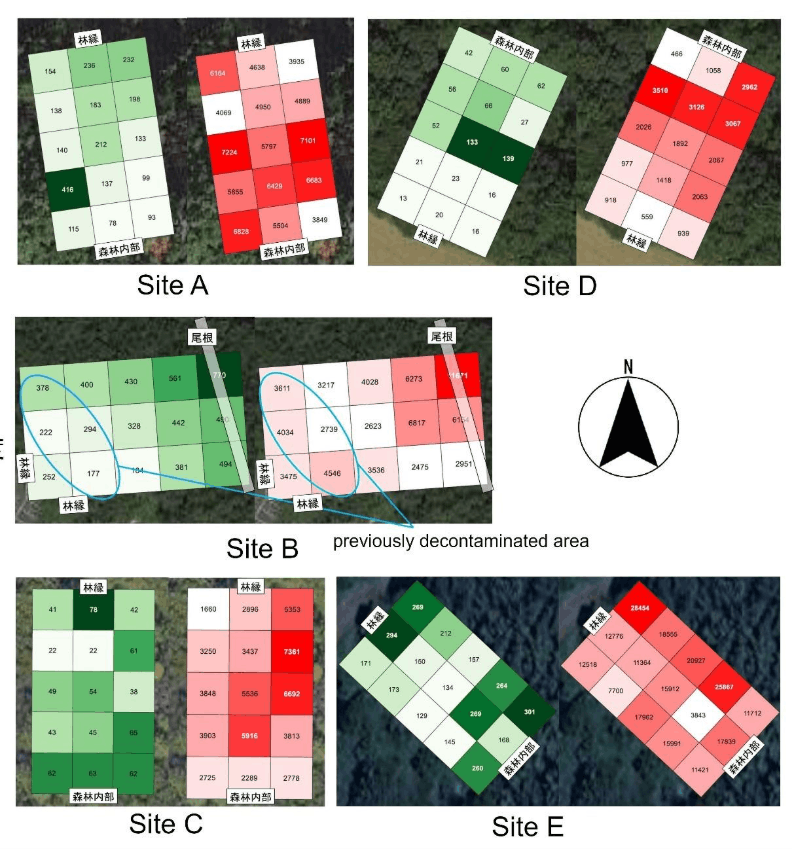
Figure 3. Spatial distribution of 137Cs concentrations in litter (green, left) and soil (red, right)
Discussion
No distinct pattern of increased concentration near the forest edge—i.e., no “forest-edge effect”—was observed at the surveyed sites, all of which were dominated by deciduous trees.
The 137Cs concentrations measured in litter were generally near or below the provisional allowable limit (400 Bq/kg).
Previous studies reporting forest-edge effects have mainly targeted coniferous forests, suggesting that in deciduous-dominated forests, such effects may not be pronounced.
Related articles
Q How is it considered that radioactive cesium-137 (137Cs) concentrations on the forest surface (forest floor) in Fukushima prefecture will change in the future?
References